Foundations of ML and AI
 Instruction and application
 Complete
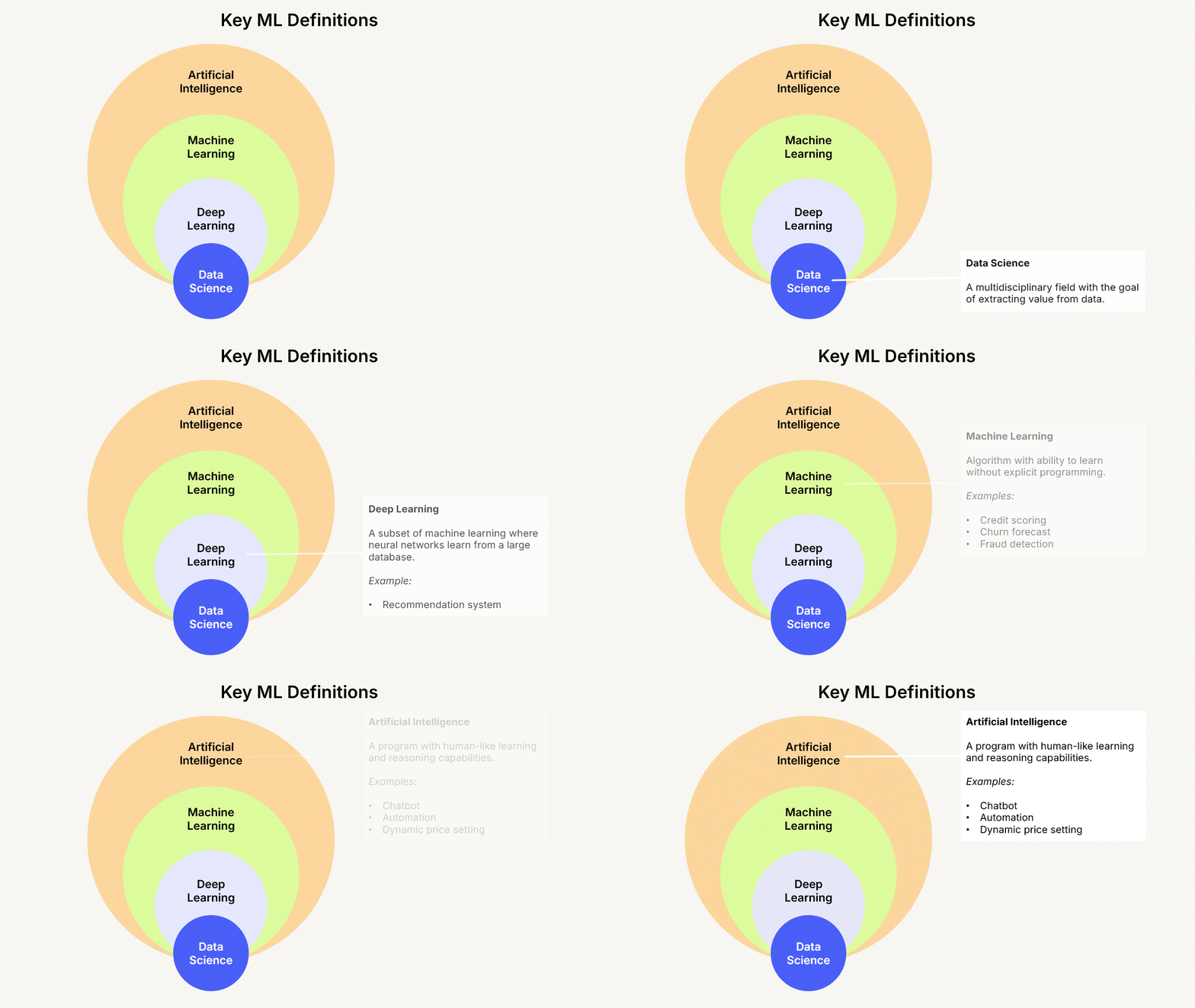
People often use ML and AI interchangeably, but they are distinct. AI refers to machines or systems that simulate human intelligence, whereas ML is a subset of AI that focuses on using algorithms to find patterns in data and learn from them.
Defining ML and AI
To ensure a shared understanding, let’s begin by defining ML and AI. As mentioned, these terms are often used interchangeably, but they are distinct.
AI refers to the development of computer systems capable of performing tasks that typically require human intelligence.ML is a subset of AI that focuses on using algorithms to find patterns in data and learn from them.


Key point
AI is a broad concept that encompasses various fields and technologies, whereas ML is a specific process to teach computers how to learn and improve from data.
The history and evolution of ML and AI
AI and ML have roots dating back to the mid-20th century. The field began with early pioneers like Alan Turing, who proposed the concept of machines that could simulate human intelligence, and John McCarthy, who coined the term ‘artificial intelligence’ in 1956.
Initially, AI focused on symbolic reasoning and logic, but progress was slow due to limitations in computing power and data.
In the 1980s, ML emerged as a key approach, emphasising the ability of systems to learn from data rather than relying solely on hard-coded rules.
In the early 2000s, the rise of big data, improved algorithms and more powerful computers created the era of ‘deep learning’ — a subset of ML. This led to significant breakthroughs in areas like speech recognition, image processing and natural language understanding, transforming AI into a driving force in modern technology.
The relationship between ML and AI
ML is a subset of AI, focusing specifically on algorithms that allow systems to learn from and make decisions based on data without being explicitly programmed. AI, as a broader field, encompasses not only ML but other techniques like rule-based systems, robotics and expert systems aimed at mimicking human intelligence. ML enables AI to automate decision-making by identifying patterns in large datasets, which is essential for applications requiring adaptability and prediction.
ML- and AI-powered systems
- In health care, AI systems powered by ML can analyse medical images (like X-rays) to identify signs of diseases such as cancer. This automation mimics human cognitive abilities like pattern recognition and judgement.
- In finance, AI-driven ML models are used to predict stock trends and detect fraudulent transactions by learning from historical data.
The ML lifecycle
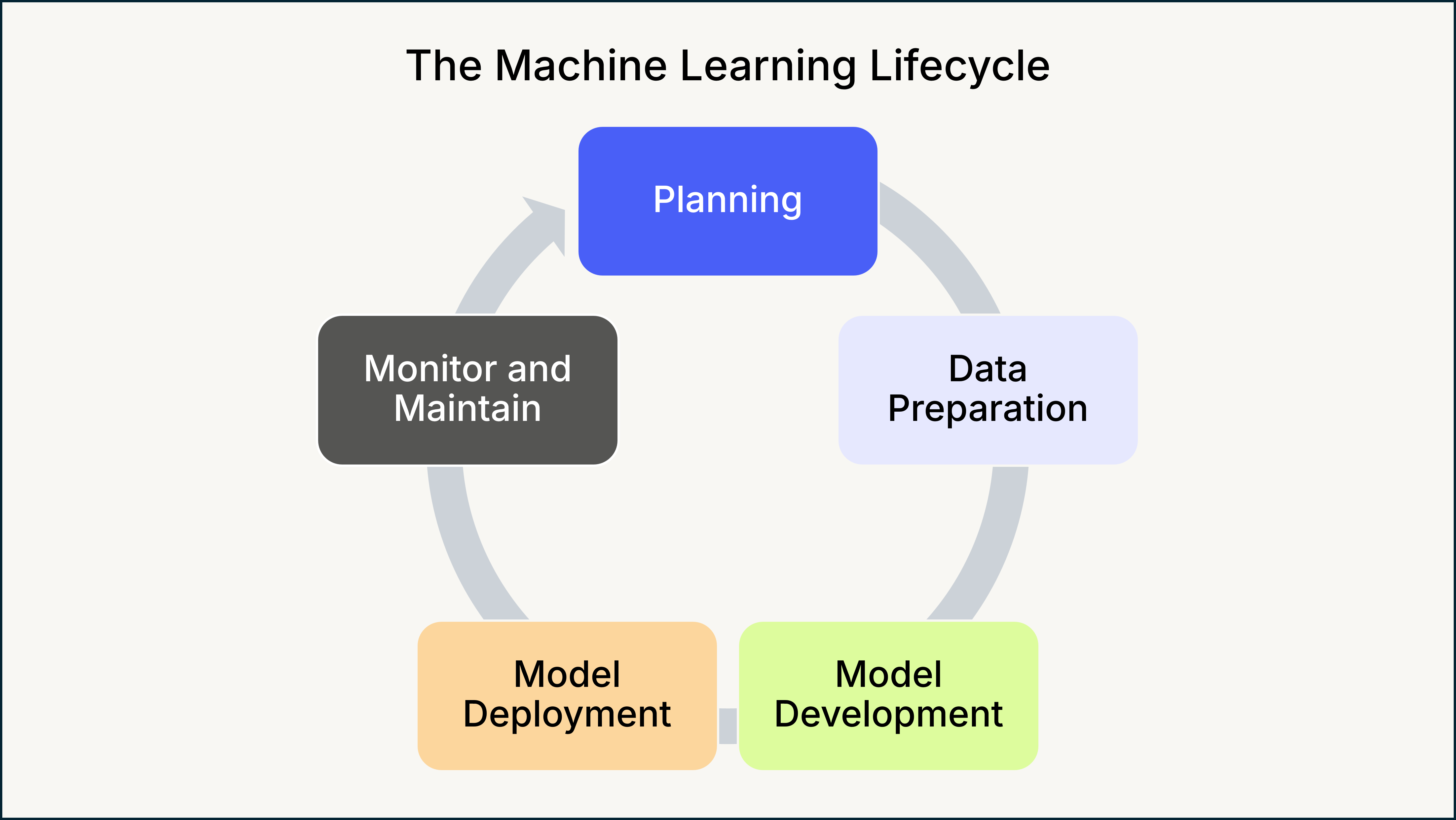
The ML lifecycle outlines the essential stages involved in developing and deploying an ML model. Each stage is crucial for ensuring the model is effective, efficient and adaptable to real-world applications.
While the core principles remain similar, the specific stages and their execution can vary depending on the context and objectives.
We'll explore a streamlined version of the ML lifecycle that includes the essential steps needed to successfully transform an ML idea into a functional, real-world solution:
- Planning: Define the problem, identify objectives and prepare the project scope.
- Data preparation: Gather and clean the data to ensure it's suitable for model training.
- Model development: Train the model on data and evaluate its performance.
- Model deployment: Put the model into production to solve real-world problems.
- Monitoring and maintenance: Continuously track performance and refine the model as necessary.