Foundational ML/AI platform architectures
 Learning
 Complete
Behind every high-performing ML system is an architecture that quietly handles millions of predictions, optimises costs, and scales without breaking a sweat. Without the right infrastructure, even the best-trained model can fall flat.

Having understood the risks involved in ML deployments in Unit 2, we now turn our attention to the underlying infrastructure to explore the fundamental architectural choices that support ML/AI systems at scale.
Defining ML/AI platform architecture
An ML/AI platform architecture is more than simply where your model runs. It's the complete ecosystem of tools, services, and infrastructure required tobuild,deploy,manage, andmonitor ML models throughout their lifecycle. This includes everything from raw data ingestion to live model serving and ongoing performance tracking.Bridging model choice and platform design
Recall from previous modules that selecting the right ML method (e.g., logistic regression, decision trees, neural networks, transformers) is crucial for solving a specific problem. What often gets overlooked is how that fundamental ML method choice has downstream effects on your platform architecture.
A simple, interpretable model might require minimal compute and a straightforward deployment, while a state-of-the-art deep learning model — while potentially offering higher accuracy — demands significant GPU resources, complex distributed training strategies, and robust low-latency serving infrastructure.
Therefore, a critical evaluation isn't just about whether a model performs well but how its inherent characteristics (such as size, computational intensity, inference speed, and data requirements) align with the operational and cost constraints of your deployment platform and, ultimately, the business objectives.
What does a robust ML/AI platform include?
At a high level, a well-structured ML platform provides all the moving parts that transform data into intelligent, scalable decisions in production. The diagram below illustrates the key components that make up a typical ML/AI platform:
These components work together to support the full model lifecycle:
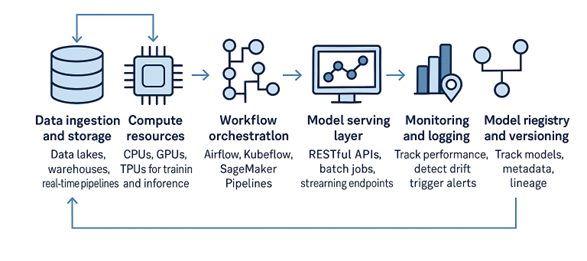
- Data ingestion and storage — systems for collecting and storing data, such as real-time pipelines, data lakes, and warehouses. These form the foundation for training and inference.
- Compute resources — infrastructure for processing, training, and serving models. This can include CPUs for standard workloads, GPUs for deep learning, or TPUs for highly parallelised operations.
- Workflow orchestration — automation tools such as Airflow, Kubeflow, or SageMaker Pipelines that schedule, manage, and monitor complex ML workflows.
- Model serving layer — mechanisms to expose models for use, such as RESTful APIs, batch scoring jobs, or streaming endpoints, depending on latency and throughput needs.
- Monitoring and logging — continuous observability systems (e.g., Prometheus, ELK, Grafana) to track performance, detect drift, and trigger alerts when something goes wrong.
- Model registry and versioning — centralised repositories for tracking model metadata, lineage, training parameters, and performance — crucial for reproducibility, governance, and safe rollbacks.
Tip
A well-designed ML/AI platform isn’t just about performance — it ensures your solution is reliable, cost-effective, scalable, and able to adapt as your data grows, your models evolve, or your business priorities shift.
<g></g><defs><clipPath><rect width="24" height="24" fill="white"></rect></clipPath></defs>## Example: Retail demand forecasting platform Imagine a national retail chain that uses ML to forecast product demand across thousands of stores. Their ML/AI platform includes:
- A data ingestion layer that pulls in daily sales data, weather trends, and promotional calendars from multiple sources.
- A training environment in the cloud that uses GPUs to retrain forecasting models weekly using new data.
- A model registry that tracks all versions of the forecasting models, hyperparameters, and their performance.
- A serving infrastructure that exposes the latest model via REST APIs to local store inventory systems, which query demand predictions in real time.
- A monitoring dashboard that tracks prediction accuracy, latency, and input data shifts — and automatically triggers retraining if accuracy drops.
- A governance layer that enforces audit logging and documentation, ensuring compliance with internal risk policies and external data regulations. Without this architecture in place, the company would struggle to coordinate updates, scale across locations, or detect when their models start drifting — leading to stockouts or overstocking that could cost millions.
Categories of ML platform architectures
Not all machine learning systems are built in the same way — or for the same purpose. The infrastructure you choose can drastically affect how fast you can deploy, how much control you have, and how well your system performs under pressure.
Let’s break down the three most common models used for acquiring and managing ML infrastructure, each with its own trade-offs in flexibility, scalability, security, and cost.
On-premises ML solutionsOn-premises ML solutions are hosted entirely within an organisation’s own data centres. This setup provides full control over infrastructure and is typically used when there are strict requirements around data privacy, latency, or compliance. It involves managing everything — from hardware provisioning to software configuration — internally.Best suited for
-
Government or defence agencies needing strict data privacy and control.
-
Enterprises with existing IT infrastructure and personnel.
-
Use cases requiring custom hardware such as FPGAs or advanced GPUs. Pros
-
Maximum control and configurability.
-
Potentially lower long-term costs for high-utilisation workloads.
-
Enhanced security when properly configured. Cons
-
High upfront capital expenditure (CAPEX).
-
Requires ongoing maintenance and IT staffing.
-
Slower to scale and update.
-
Risk of resource underutilisation. Example scenario
A national healthcare agency needs to host ML models that process patient data under strict regulatory controls. On-premises deployment ensures full ownership of data and infrastructure, with no external exposure.
Platform as a Service (PaaS) for MLPaaS solutions offer ready-made AI capabilities via APIs. These services require no training or hosting, making them a fast and easy way to embed AI into applications — especially when the use case is standard and doesn't require customisation.Best suited for
-
Teams that want to focus on model development instead of managing infrastructure.
-
Projects that require scalable and elastic compute resources.
-
Organisations that want a balance between controland** ease of use**.Pros
-
Faster time to deployment.
-
Easy scaling and automation.
-
Access to pre-integrated tools (e.g., notebooks, AutoML, pipelines). Cons
-
Vendor lock-in risk.
-
Costs can scale quickly with usage.
-
Limited low-level control of the infrastructure.Example scenario A fast-growing fintech startup is launching a real-time fraud detection model. With limited DevOps capacity, they useGoogle Cloud Vertex AI to deploy their models with CI/CD and auto-scaling enabled — no infrastructure headaches.Software as a Service (SaaS) for MLSaaS offerings arefully managed AI capabilities, ready to integrate via APIs. You don’t train or host the model — you simply call the service and get predictions.Best suited for
-
Small teams or companies without dedicated ML engineers.
-
Use cases where ML is not core to the business but adds value.
-
Applications requiring fast, out-of-the-box functionality. Pros
-
No infrastructure or pipeline management.
-
Fastest to implement.
-
Simple cost-per-use pricing. Cons
-
Least customisation or control.
-
Data privacy concerns (data must be sent to a third party).
-
Performance dependent on vendor updates and service quality. Example scenario A small e-commerce business wants to use image recognition to automatically tag products. Instead of building a model, they integrate with AWS Rekognition, a SaaS solution that delivers instant results without any ML expertise.
Action item: ** Choosing the right ML architecture checkpoint**
You’re advising three different organisations on deploying machine learning solutions. Each one has different constraints — technical, operational, or regulatory. Your task is to recommend the most appropriate ML platform architecture based on their needs.