Model training methods and strategies
 Instruction and application
 Complete
Building a successful model involves more than just selecting the right algorithm. How you train your model and whether you use a single model or combine multiple models significantly impacts its performance, efficiency and adaptability.
Having a clear understanding of the different training methods and model strategies available in ML will enable you to build more effective and adaptable models for a wide range of applications.
Method vs strategy
While the training method dictates how a model learns from data, the model strategy determines how trained models are utilised for prediction.
Model training methods: Batch learning vs online learning
ML models learn from data, but how they process that data during training can significantly impact their performance, efficiency and adaptability. Two primary training methods dictate how a model interacts with data over time: batch learning (offline) andonline learning.
Batch learning
In batch learning, the model is trained on the entire dataset at once. The model ‘sees’ all the available data in one go and updates its parameters based on the collective information. This process is typically done offline, meaning the model isn't actively learning while making predictions.
Batch learning use cases
- Image classification: Training a model to recognise objects in images using a large, labelled dataset.
- Medical diagnosis: Predicting diseases based on patient medical records.
- Customer churn prediction: Predicting which customers are likely to cancel a subscription based on past behaviour.
- Spam detection: Training a spam filter on a large collection of emails.
- Credit risk assessment: Evaluating the creditworthiness of loan applicants.
When should I use batch learning? Choose batch learning when you have a fixed dataset, need high accuracy and can afford the computational cost of training on the entire dataset at once.
Online learning
Unlike batch learning, online learning trains a model incrementally as data arrives in a stream or sequence. Instead of processing all the data in one go, online learning updates the model's parameters after seeing each data point or small batches of data. This iterative process allows the model to continuously adapt to new information and evolve.
Online learning use cases
- Spam filtering: Continuously updating a spam filter as new emails arrive.
- Recommendation systems: Personalising recommendations from real-time interactions.
- Stock price prediction: Predicting prices based on continuously streaming market data.
- Network intrusion detection: Analysing network traffic in real time.
- Personalised medicine: Adjusting treatment plans based on ongoing physiological data.
- Online advertising: Personalising ads based on real-time behavior.
When should I use online learning? Choose online learning when you have streaming data, need a model that adapts to changing patterns or when the dataset is too large to fit in memory.
Key differences between batch learning and online learning
The two types of training methods vary greatly on their approach to data handling, adaptability and resource requirements.
| Batch learning | Feature | Online learning |
|---|---|---|
| Entire dataset required upfront | Data access | Data arrives sequentially or in a stream |
| Trains on the entire dataset at once | Training style | Trains incrementally on data points/batches |
| High, especially for large datasets | Computational cost | Lower, processes data in smaller chunks |
| High, needs to store entire dataset in memory | Memory usage | Low, only needs current data point/batch |
| Static, requires retraining for new data | Adaptability | Dynamic, adapts to changing distributions |
| Infrequent, after processing entire dataset | Update frequency | Frequent, after each data point or batch |
| Slower training, faster prediction | Time efficiency | Faster training (per update), potential slower overall |
| Static environments, fixed datasets | Suitable environment | Dynamic environments, streaming data |
| Image classification on fixed dataset | Use case | Spam filtering, recommender systems |
Model strategies
Another crucial aspect of building effective ML models is choosing the right strategy for deploying those models. In this section, we'll focus on the distinction between single models and ensemble methods.
Single models
A single model is trained on the dataset and is solely responsible for making predictions. This model can be any type of ML algorithm, such as a linear regression, a decision tree, a support vector machine or a neural network.
Ensemble methods
Ensemble methods combine predictions from multiple models (often called ‘weak learners’) to achieve better overall performance. The idea is that by aggregating the predictions of diverse models, the ensemble can overcome the limitations of individual models and make more robust and accurate predictions.
Stacking
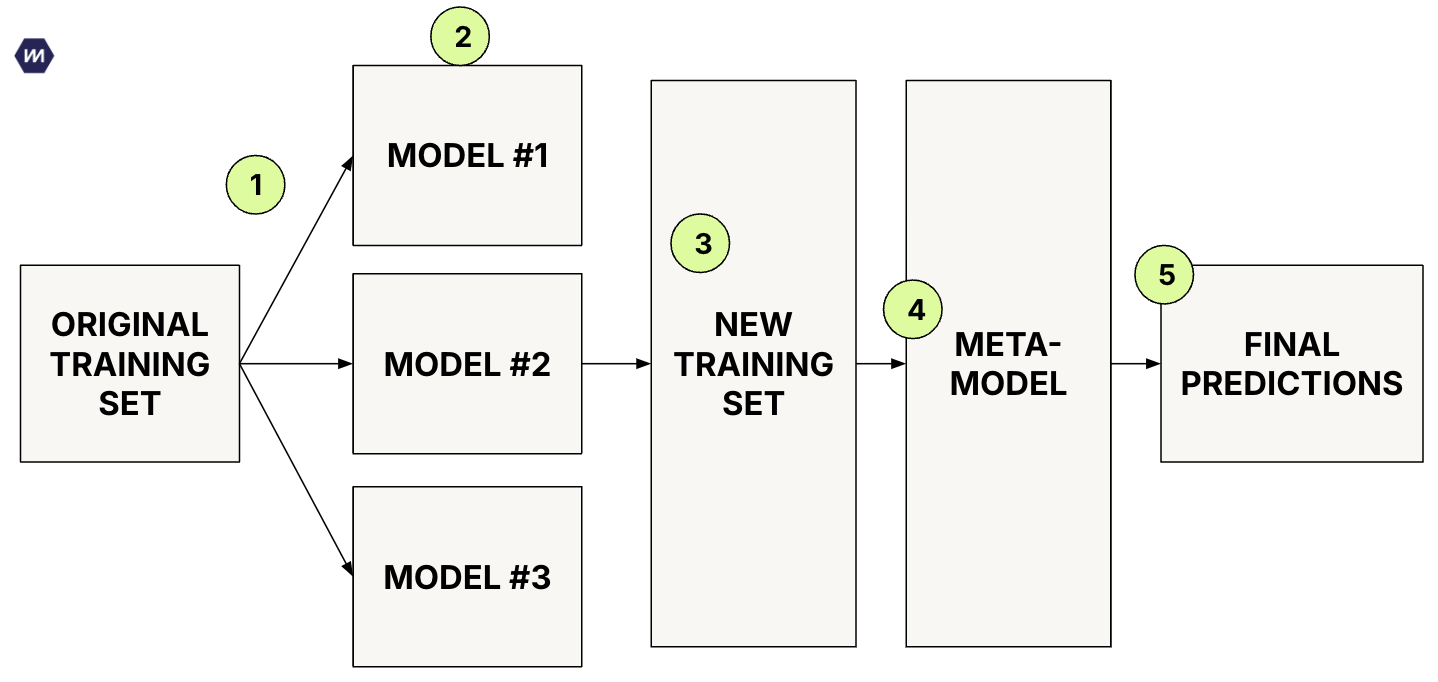
In the stacking process, the initial models tend to be super complex (sometimes even neural networks or deep learning), while the meta-model is often very simple (much like a linear model).
- Step 1 - Split the training data: Divide the original training data into two parts: one for training the base models and one for training the meta-model.
- Step 2 - Train base models: Train multiple diverse base models using the first part of the training data.
- Step 3 - Create new training set from model predictions: The predictions from the initial three models serve as the new training set.
- Step 4 - Train the meta-model: Train a meta-model using the predictions from the base models as input features.
- Step 5 - Final prediction: Feed the predictions of the base models from the test dataset into the meta-model.
Bagging (bootstrap aggregating)
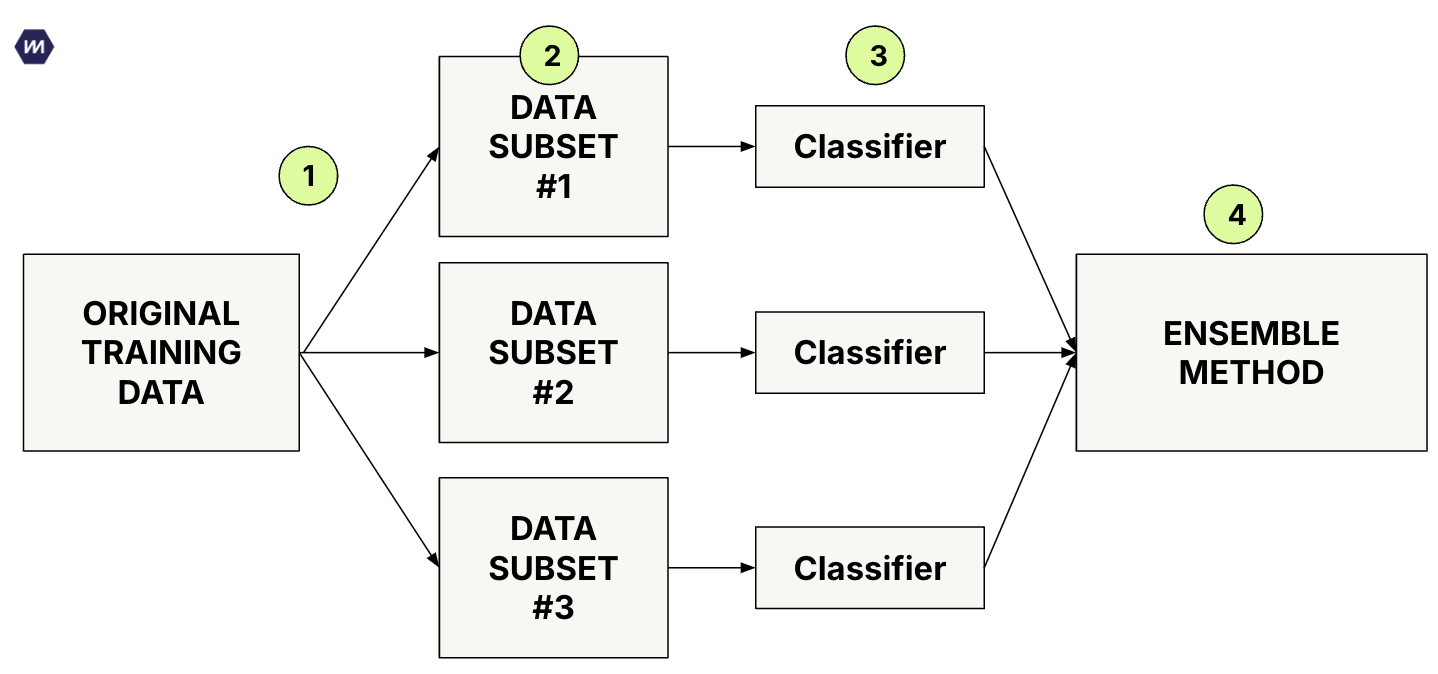
Bagging is a homogeneous weak learners’ model that learns from each other independently in parallel and combines them for determining the model average.
- Step 1: Randomly selects subsets of the training data with replacement (bootstrapping).
- Step 2: Trains separate base models (e.g. decision trees) on each bootstrap sample independently.
- Step 3: For each instance, collect predictions from all the base models (aggregating).
- Step 4: Combine the predictions of all base models to make the final prediction.
Boosting
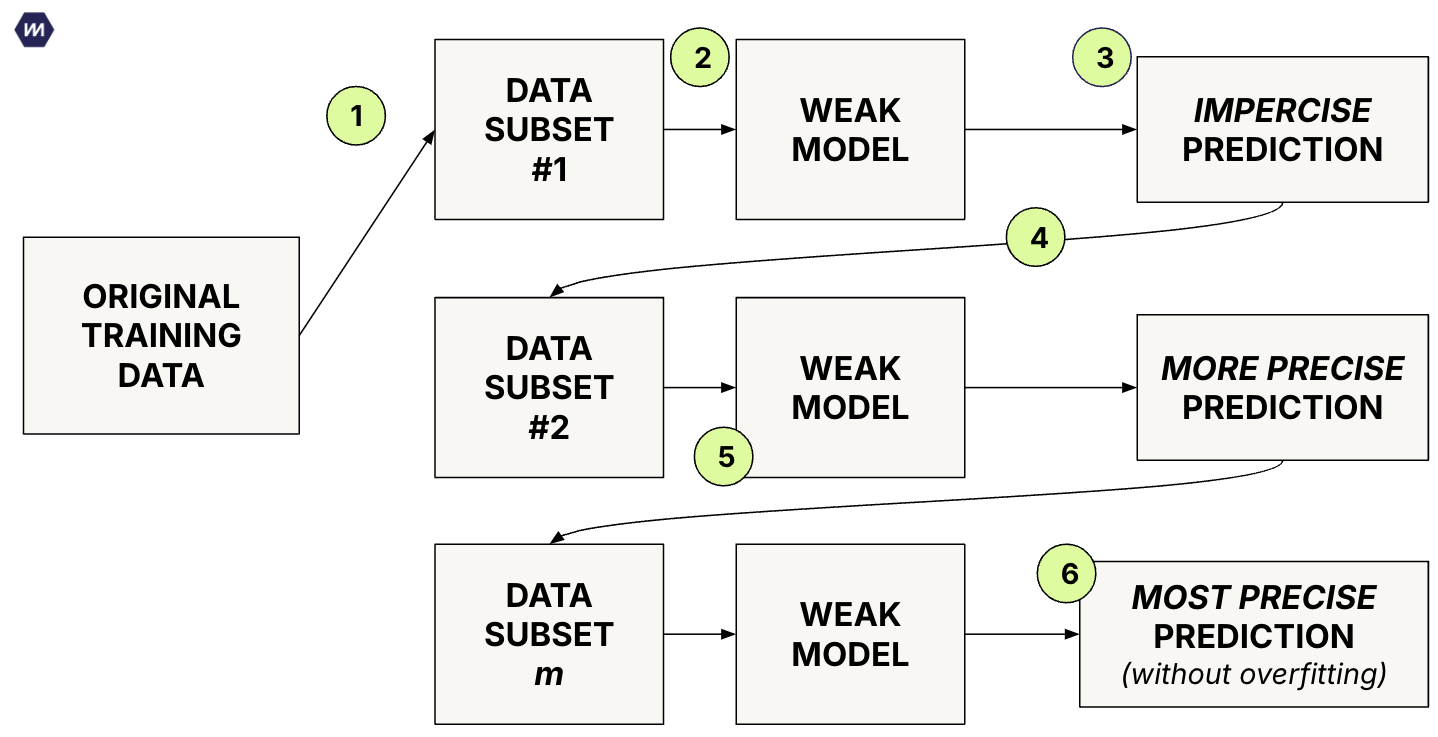
Sequentially trains models, where each subsequent model focuses on correcting the errors of the previous models.
- Step 1 - Initialise equal weights: Each instance in the training set is assigned an equal weight.
- Step 2 - Train a weak model: Fit a weak base model to the training data.
- Step 3 - Update instance weights: Assess the errors and increase weights of incorrectly classified instances.
- Step 4 - Train another weak model: Create another weak model, emphasising correcting previous mistakes.
- Step 5 - Combine models with weights: Assign weights to each weak model based on its performance.
- Step 6 - Make final prediction: Combine weighted predictions to make the most precise prediction.
Choosing the right strategy
The choice between a single model and an ensemble depends on several factors:
- Performance requirements: If high accuracy is crucial, ensembles are often the better choice.
- Computational resources: Ensembles require more resources for training and deployment.
- Interpretability needs: If explainability is important, a simpler single model might be preferred.
- Dataset size and complexity: Ensembles are particularly effective for large and complex datasets.
- Time constraints: Training and tuning an ensemble can be more time-consuming.
Here is the updated code:
id: 3-model-training-methods-and-strategies title: "Model training methods and strategies"
Instruction and applicationCompleteBuilding a successful model involves more than just selecting the right algorithm. How you train your model and whether you use a single model or combine multiple models significantly impacts its performance, efficiency and adaptability.
Having a clear understanding of the different training methods and model strategies available in ML will enable you to build more effective and adaptable models for a wide range of applications.
Method vs strategy
While the training method dictates how a model learns from data, the model strategy determines how trained models are utilised for prediction.
Model training methods: Batch learning vs online learning
ML models learn from data, but how they process that data during training can significantly impact their performance, efficiency and adaptability. Two primary training methods dictate how a model interacts with data over time: batch learning (offline) andonline learning.
Batch learning
In batch learning, the model is trained on the entire dataset at once. The model ‘sees’ all the available data in one go and updates its parameters based on the collective information. This process is typically done offline, meaning the model isn't actively learning while making predictions.
Batch learning use cases
- Image classification: Training a model to recognise objects in images using a large, labelled dataset.
- Medical diagnosis: Predicting diseases based on patient medical records.
- Customer churn prediction: Predicting which customers are likely to cancel a subscription based on past behaviour.
- Spam detection: Training a spam filter on a large collection of emails.
- Credit risk assessment: Evaluating the creditworthiness of loan applicants.
When should I use batch learning? Choose batch learning when you have a fixed dataset, need high accuracy and can afford the computational cost of training on the entire dataset at once.
Online learning
Unlike batch learning, online learning trains a model incrementally as data arrives in a stream or sequence. Instead of processing all the data in one go, online learning updates the model's parameters after seeing each data point or small batches of data. This iterative process allows the model to continuously adapt to new information and evolve.
Online learning use cases
- Spam filtering: Continuously updating a spam filter as new emails arrive.
- Recommendation systems: Personalising recommendations from real-time interactions.
- Stock price prediction: Predicting prices based on continuously streaming market data.
- Network intrusion detection: Analysing network traffic in real time.
- Personalised medicine: Adjusting treatment plans based on ongoing physiological data.
- Online advertising: Personalising ads based on real-time behavior.
When should I use online learning? Choose online learning when you have streaming data, need a model that adapts to changing patterns or when the dataset is too large to fit in memory.
Key differences between batch learning and online learning
The two types of training methods vary greatly on their approach to data handling, adaptability and resource requirements.
| Batch learning | Feature | Online learning |
|---|---|---|
| Entire dataset required upfront | Data access | Data arrives sequentially or in a stream |
| Trains on the entire dataset at once | Training style | Trains incrementally on data points/batches |
| High, especially for large datasets | Computational cost | Lower, processes data in smaller chunks |
| High, needs to store entire dataset in memory | Memory usage | Low, only needs current data point/batch |
| Static, requires retraining for new data | Adaptability | Dynamic, adapts to changing distributions |
| Infrequent, after processing entire dataset | Update frequency | Frequent, after each data point or batch |
| Slower training, faster prediction | Time efficiency | Faster training (per update), potential slower overall |
| Static environments, fixed datasets | Suitable environment | Dynamic environments, streaming data |
| Image classification on fixed dataset | Use case | Spam filtering, recommender systems |
Model strategies
Another crucial aspect of building effective ML models is choosing the right strategy for deploying those models. In this section, we'll focus on the distinction between single models and ensemble methods.
Single models
A single model is trained on the dataset and is solely responsible for making predictions. This model can be any type of ML algorithm, such as a linear regression, a decision tree, a support vector machine or a neural network.
Ensemble methods
Ensemble methods combine predictions from multiple models (often called ‘weak learners’) to achieve better overall performance. The idea is that by aggregating the predictions of diverse models, the ensemble can overcome the limitations of individual models and make more robust and accurate predictions.
Stacking
In the stacking process, the initial models tend to be super complex (sometimes even neural networks or deep learning), while the meta-model is often very simple (much like a linear model).
- Step 1 - Split the training data: Divide the original training data into two parts: one for training the base models and one for training the meta-model.
- Step 2 - Train base models: Train multiple diverse base models using the first part of the training data.
- Step 3 - Create new training set from model predictions: The predictions from the initial three models serve as the new training set.
- Step 4 - Train the meta-model: Train a meta-model using the predictions from the base models as input features.
- Step 5 - Final prediction: Feed the predictions of the base models from the test dataset into the meta-model.
Bagging (bootstrap aggregating)
Bagging is a homogeneous weak learners’ model that learns from each other independently in parallel and combines them for determining the model average.
- Step 1: Randomly selects subsets of the training data with replacement (bootstrapping).
- Step 2: Trains separate base models (e.g. decision trees) on each bootstrap sample independently.
- Step 3: For each instance, collect predictions from all the base models (aggregating).
- Step 4: Combine the predictions of all base models to make the final prediction.
Boosting
Sequentially trains models, where each subsequent model focuses on correcting the errors of the previous models.
- Step 1 - Initialise equal weights: Each instance in the training set is assigned an equal weight.
- Step 2 - Train a weak model: Fit a weak base model to the training data.
- Step 3 - Update instance weights: Assess the errors and increase weights of incorrectly classified instances.
- Step 4 - Train another weak model: Create another weak model, emphasising correcting previous mistakes.
- Step 5 - Combine models with weights: Assign weights to each weak model based on its performance.
- Step 6 - Make final prediction: Combine weighted predictions to make the most precise prediction.
Choosing the right strategy
The choice between a single model and an ensemble depends on several factors:
- Performance requirements: If high accuracy is crucial, ensembles are often the better choice.
- Computational resources: Ensembles require more resources for training and deployment.
- Interpretability needs: If explainability is important, a simpler single model might be preferred.
- Dataset size and complexity: Ensembles are particularly effective for large and complex datasets.
- Time constraints: Training and tuning an ensemble can be more time-consuming.
Here is the updated code:
id: 3-model-training-methods-and-strategies title: "Model training methods and strategies"
Instruction and applicationCompleteBuilding a successful model involves more than just selecting the right algorithm. How you train your model and whether you use a single model or combine multiple models significantly impacts its performance, efficiency and adaptability.
Having a clear understanding of the different training methods and model strategies available in ML will enable you to build more effective and adaptable models for a wide range of applications.
Method vs strategy
While the training method dictates how a model learns from data, the model strategy determines how trained models are utilised for prediction.
Model training methods: Batch learning vs online learning
ML models learn from data, but how they process that data during training can significantly impact their performance, efficiency and adaptability. Two primary training methods dictate how a model interacts with data over time: batch learning (offline) andonline learning.
Batch learning
In batch learning, the model is trained on the entire dataset at once. The model ‘sees’ all the available data in one go and updates its parameters based on the collective information. This process is typically done offline, meaning the model isn't actively learning while making predictions.
Batch learning use cases
- Image classification: Training a model to recognise objects in images using a large, labelled dataset.
- Medical diagnosis: Predicting diseases based on patient medical records.
- Customer churn prediction: Predicting which customers are likely to cancel a subscription based on past behaviour.
- Spam detection: Training a spam filter on a large collection of emails.
- Credit risk assessment: Evaluating the creditworthiness of loan applicants.
When should I use batch learning? Choose batch learning when you have a fixed dataset, need high accuracy and can afford the computational cost of training on the entire dataset at once.
Online learning
Unlike batch learning, online learning trains a model incrementally as data arrives in a stream or sequence. Instead of processing all the data in one go, online learning updates the model's parameters after seeing each data point or small batches of data. This iterative process allows the model to continuously adapt to new information and evolve.
Online learning use cases
- Spam filtering: Continuously updating a spam filter as new emails arrive.
- Recommendation systems: Personalising recommendations from real-time interactions.
- Stock price prediction: Predicting prices based on continuously streaming market data.
- Network intrusion detection: Analysing network traffic in real time.
- Personalised medicine: Adjusting treatment plans based on ongoing physiological data.
- Online advertising: Personalising ads based on real-time behavior.
When should I use online learning? Choose online learning when you have streaming data, need a model that adapts to changing patterns or when the dataset is too large to fit in memory.
Key differences between batch learning and online learning
The two types of training methods vary greatly on their approach to data handling, adaptability and resource requirements.
| Batch learning | Feature | Online learning |
|---|---|---|
| Entire dataset required upfront | Data access | Data arrives sequentially or in a stream |
| Trains on the entire dataset at once | Training style | Trains incrementally on data points/batches |
| High, especially for large datasets | Computational cost | Lower, processes data in smaller chunks |
| High, needs to store entire dataset in memory | Memory usage | Low, only needs current data point/batch |
| Static, requires retraining for new data | Adaptability | Dynamic, adapts to changing distributions |
| Infrequent, after processing entire dataset | Update frequency | Frequent, after each data point or batch |
| Slower training, faster prediction | Time efficiency | Faster training (per update), potential slower overall |
| Static environments, fixed datasets | Suitable environment | Dynamic environments, streaming data |
| Image classification on fixed dataset | Use case | Spam filtering, recommender systems |
Model strategies
Another crucial aspect of building effective ML models is choosing the right strategy for deploying those models. In this section, we'll focus on the distinction between single models and ensemble methods.
Single models
A single model is trained on the dataset and is solely responsible for making predictions. This model can be any type of ML algorithm, such as a linear regression, a decision tree, a support vector machine or a neural network.
Ensemble methods
Ensemble methods combine predictions from multiple models (often called ‘weak learners’) to achieve better overall performance. The idea is that by aggregating the predictions of diverse models, the ensemble can overcome the limitations of individual models and make more robust and accurate predictions.
Stacking
In the stacking process, the initial models tend to be super complex (sometimes even neural networks or deep learning), while the meta-model is often very simple (much like a linear model).
- Step 1 - Split the training data: Divide the original training data into two parts: one for training the base models and one for training the meta-model.
- Step 2 - Train base models: Train multiple diverse base models using the first part of the training data.
- Step 3 - Create new training set from model predictions: The predictions from the initial three models serve as the new training set.
- Step 4 - Train the meta-model: Train a meta-model using the predictions from the base models as input features.
- Step 5 - Final prediction: Feed the predictions of the base models from the test dataset into the meta-model.
Bagging (bootstrap aggregating)
Bagging is a homogeneous weak learners’ model that learns from each other independently in parallel and combines them for determining the model average.
- Step 1: Randomly selects subsets of the training data with replacement (bootstrapping).
- Step 2: Trains separate base models (e.g. decision trees) on each bootstrap sample independently.
- Step 3: For each instance, collect predictions from all the base models (aggregating).
- Step 4: Combine the predictions of all base models to make the final prediction.
Boosting
Sequentially trains models, where each subsequent model focuses on correcting the errors of the previous models.
- Step 1 - Initialise equal weights: Each instance in the training set is assigned an equal weight.
- Step 2 - Train a weak model: Fit a weak base model to the training data.
- Step 3 - Update instance weights: Assess the errors and increase weights of incorrectly classified instances.
- Step 4 - Train another weak model: Create another weak model, emphasising correcting previous mistakes.
- Step 5 - Combine models with weights: Assign weights to each weak model based on its performance.
- Step 6 - Make final prediction: Combine weighted predictions to make the most precise prediction.
Choosing the right strategy
The choice between a single model and an ensemble depends on several factors:
- Performance requirements: If high accuracy is crucial, ensembles are often the better choice.
- Computational resources: Ensembles require more resources for training and deployment.
- Interpretability needs: If explainability is important, a simpler single model might be preferred.
- Dataset size and complexity: Ensembles are particularly effective for large and complex datasets.
- Time constraints: Training and tuning an ensemble can be more time-consuming.
Here is the updated code:
id: 3-model-training-methods-and-strategies title: "Model training methods and strategies"
Instruction and applicationCompleteBuilding a successful model involves more than just selecting the right algorithm. How you train your model and whether you use a single model or combine multiple models significantly impacts its performance, efficiency and adaptability.
Having a clear understanding of the different training methods and model strategies available in ML will enable you to build more effective and adaptable models for a wide range of applications.
Method vs strategy
While the training method dictates how a model learns from data, the model strategy determines how trained models are utilised for prediction.
Model training methods: Batch learning vs online learning
ML models learn from data, but how they process that data during training can significantly impact their performance, efficiency and adaptability. Two primary training methods dictate how a model interacts with data over time: batch learning (offline) andonline learning.
Batch learning
In batch learning, the model is trained on the entire dataset at once. The model ‘sees’ all the available data in one go and updates its parameters based on the collective information. This process is typically done offline, meaning the model isn't actively learning while making predictions.
Batch learning use cases
- Image classification: Training a model to recognise objects in images using a large, labelled dataset.
- Medical diagnosis: Predicting diseases based on patient medical records.
- Customer churn prediction: Predicting which customers are likely to cancel a subscription based on past behaviour.
- Spam detection: Training a spam filter on a large collection of emails.
- Credit risk assessment: Evaluating the creditworthiness of loan applicants.
When should I use batch learning? Choose batch learning when you have a fixed dataset, need high accuracy and can afford the computational cost of training on the entire dataset at once.
Online learning
Unlike batch learning, online learning trains a model incrementally as data arrives in a stream or sequence. Instead of processing all the data in one go, online learning updates the model's parameters after seeing each data point or small batches of data. This iterative process allows the model to continuously adapt to new information and evolve.
Online learning use cases
- Spam filtering: Continuously updating a spam filter as new emails arrive.
- Recommendation systems: Personalising recommendations from real-time interactions.
- Stock price prediction: Predicting prices based on continuously streaming market data.
- Network intrusion detection: Analysing network traffic in real time.
- Personalised medicine: Adjusting treatment plans based on ongoing physiological data.
- Online advertising: Personalising ads based on real-time behavior.
When should I use online learning? Choose online learning when you have streaming data, need a model that adapts to changing patterns or when the dataset is too large to fit in memory.
Key differences between batch learning and online learning
The two types of training methods vary greatly on their approach to data handling, adaptability and resource requirements.
| Batch learning | Feature | Online learning |
|---|---|---|
| Entire dataset required upfront | Data access | Data arrives sequentially or in a stream |
| Trains on the entire dataset at once | Training style | Trains incrementally on data points/batches |
| High, especially for large datasets | Computational cost | Lower, processes data in smaller chunks |
| High, needs to store entire dataset in memory | Memory usage | Low, only needs current data point/batch |
| Static, requires retraining for new data | Adaptability | Dynamic, adapts to changing distributions |
| Infrequent, after processing entire dataset | Update frequency | Frequent, after each data point or batch |
| Slower training, faster prediction | Time efficiency | Faster training (per update), potential slower overall |
| Static environments, fixed datasets | Suitable environment | Dynamic environments, streaming data |
| Image classification on fixed dataset | Use case | Spam filtering, recommender systems |
Model strategies
Another crucial aspect of building effective ML models is choosing the right strategy for deploying those models. In this section, we'll focus on the distinction between single models and ensemble methods.
Single models
A single model is trained on the dataset and is solely responsible for making predictions. This model can be any type of ML algorithm, such as a linear regression, a decision tree, a support vector machine or a neural network.
Ensemble methods
Ensemble methods combine predictions from multiple models (often called ‘weak learners’) to achieve better overall performance. The idea is that by aggregating the predictions of diverse models, the ensemble can overcome the limitations of individual models and make more robust and accurate predictions.
Stacking
In the stacking process, the initial models tend to be super complex (sometimes even neural networks or deep learning), while the meta-model is often very simple (much like a linear model).
- Step 1 - Split the training data: Divide the original training data into two parts: one for training the base models and one for training the meta-model.
- Step 2 - Train base models: Train multiple diverse base models using the first part of the training data.
- Step 3 - Create new training set from model predictions: The predictions from the initial three models serve as the new training set.
- Step 4 - Train the meta-model: Train a meta-model using the predictions from the base models as input features.
- Step 5 - Final prediction: Feed the predictions of the base models from the test dataset into the meta-model.
Bagging (bootstrap aggregating)
Bagging is a homogeneous weak learners’ model that learns from each other independently in parallel and combines them for determining the model average.
- Step 1: Randomly selects subsets of the training data with replacement (bootstrapping).
- Step 2: Trains separate base models (e.g. decision trees) on each bootstrap sample independently.
- Step 3: For each instance, collect predictions from all the base models (aggregating).
- Step 4: Combine the predictions of all base models to make the final prediction.
Boosting
Sequentially trains models, where each subsequent model focuses on correcting the errors of the previous models.
- Step 1 - Initialise equal weights: Each instance in the training set is assigned an equal weight.
- Step 2 - Train a weak model: Fit a weak base model to the training data.
- Step 3 - Update instance weights: Assess the errors and increase weights of incorrectly classified instances.
- Step 4 - Train another weak model: Create another weak model, emphasising correcting previous mistakes.
- Step 5 - Combine models with weights: Assign weights to each weak model based on its performance.
- Step 6 - Make final prediction: Combine weighted predictions to make the most precise prediction.
Choosing the right strategy
The choice between a single model and an ensemble depends on several factors:
- Performance requirements: If high accuracy is crucial, ensembles are often the better choice.
- Computational resources: Ensembles require more resources for training and deployment.
- Interpretability needs: If explainability is important, a simpler single model might be preferred.
- Dataset size and complexity: Ensembles are particularly effective for large and complex datasets.
- Time constraints: Training and tuning an ensemble can be more time-consuming.