Hyperparameter tuning strategies
 Instruction and application
 Complete
Unlock your model’s hidden potential
Imagine unlocking your model’s hidden potential with just a few well-placed tweaks.
True performance isn’t just about algorithms—it’s about fine-tuning the hyperparameters that guide learning. A few small adjustments can transform a model from average to exceptional. In this section, you’ll learn how to adjust these critical settings to boost accuracy and reduce errors.

Knobs and dials of Machine Learning
Hyperparameters dictate aspects of the training process and the model’s architecture. They are the "knobs and dials" you turn to influence how the model learns.
Poorly chosen hyperparameters can lead to:
- Underfitting: The model fails to capture underlying patterns.
- Overfitting: The model picks up too much noise and fails to generalise.
- Suboptimal performance: The model doesn't reach its full potential.
Common tuning techniques
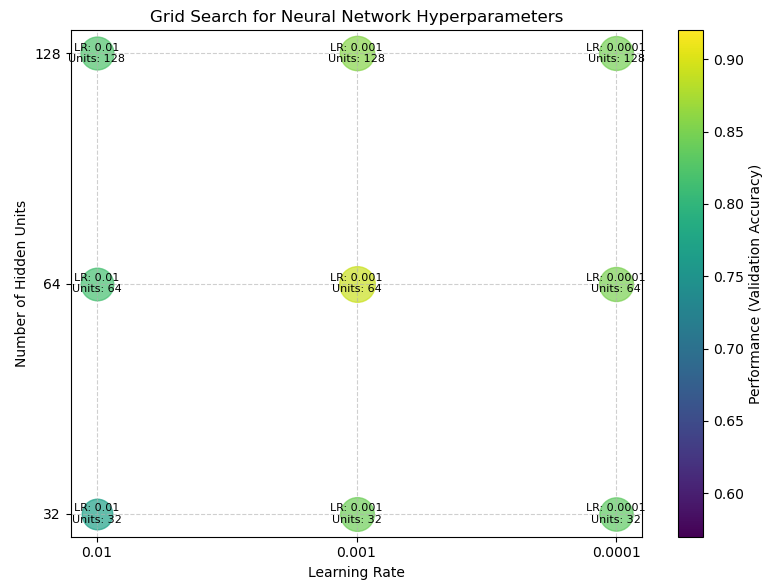
1. Grid Search
An exhaustive method that evaluates every possible combination of hyperparameters from a defined set.
- How it works: If testing learning rates [0.01, 0.1] and layers [1, 2], it trains 4 models for every pairing.
- When to use: When you have a small number of hyperparameters and discrete values to test.
- Benefits: Guaranteed to find the best combination within your defined set.
- Risks: Extremely computationally expensive as the number of parameters grows.
2. Random Search
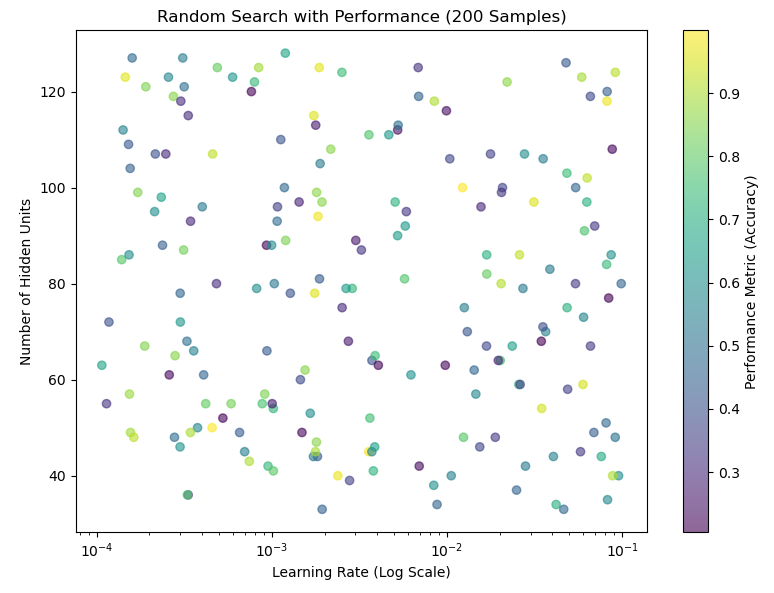
Instead of trying every combination, Random Search samples values from a defined distribution for a fixed number of iterations.
- How it works: You define a range (e.g., learning rate between 0.001 and 0.1) and a "budget" of trials.
- Benefits: More efficient than Grid Search for high-dimensional data; can explore continuous ranges.
- Risks: No guarantee of finding the absolute best combination.
3. Bayesian Optimisation
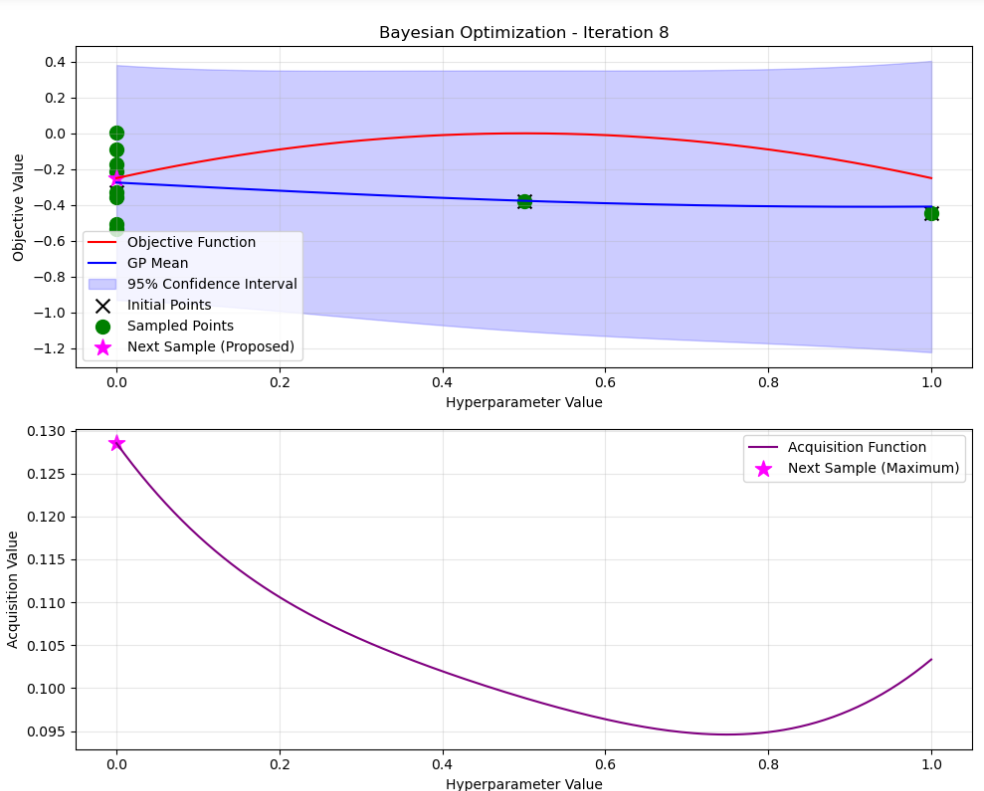
A more intelligent approach that uses a probabilistic model to reason about which hyperparameters are likely to yield the best results based on past trials.
- Benefits: Finds good hyperparameters with significantly fewer evaluations.
- When to use: When evaluating a single model is expensive (e.g., Deep Learning).
Balance automation with understanding
- Automated tools (scikit-learn, Keras, SageMaker) save time but require interpretation.
- Tune for impact: The best hyperparameters align with business goals (e.g., prioritizing recall in medical diagnosis).
Type your reflection here...
Type your reflection here...
Type your reflection here...